
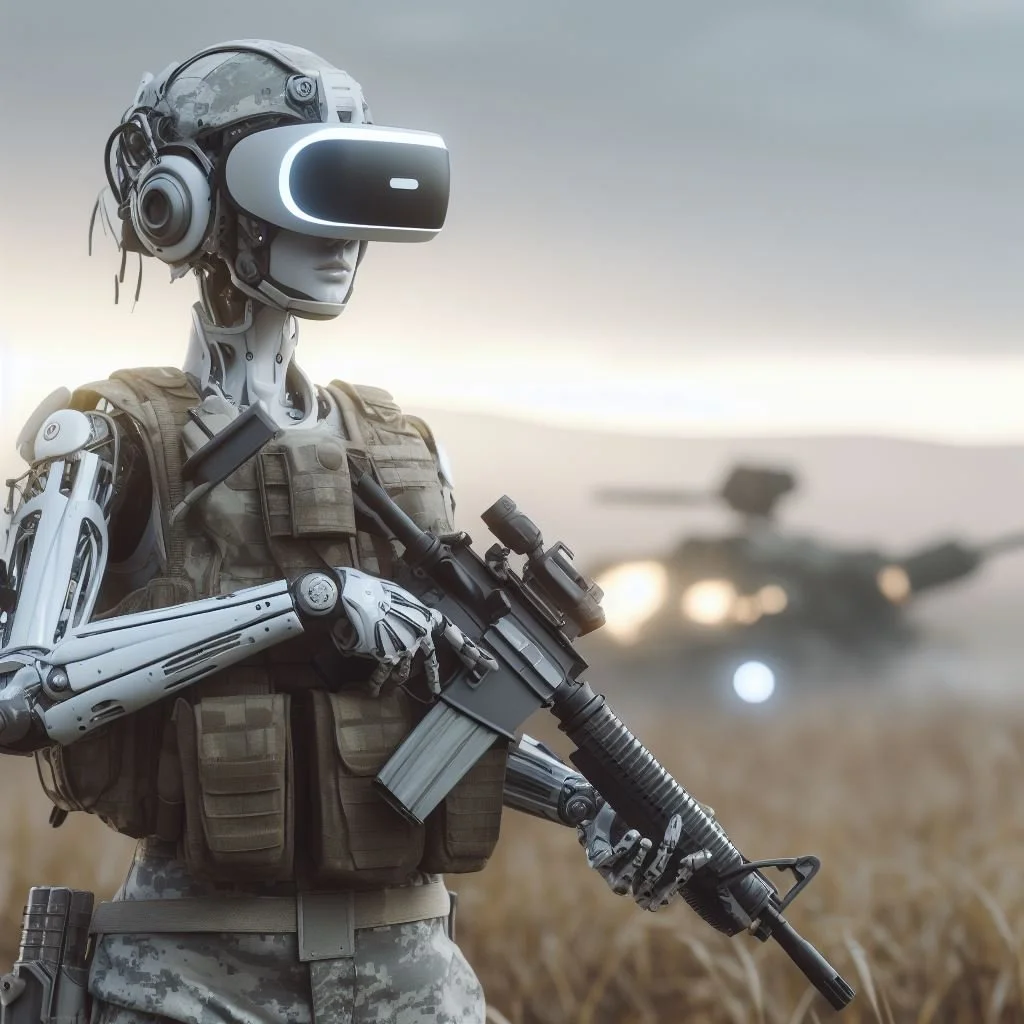
In the 19th century, battlefields were located in open fields hidden from public scrutiny. In the 20th century, and especially in the 1930s, the battlefield moved into cities, where victory or defeat was shaped by urban buildings and architecture. In the 21st century, the battlefield has moved on to cyberspace where it is no longer constrained by physical realities. Aggressor and defender are no longer engaged face to face, but on screens thousands of miles apart.
Augmented soldiers, whether wearing exoskeletons or an AR helmets, can gather and transmit real-time information, helping them to better identify their targets.
The Russian-Ukrainian conflict has shown that the art of warfare is undergoing yet another technological evolution. We are certainly not in the massive use of autonomous military robots like the Terminator,but in a theater of operations using semi-autonomous drones that can accurately destroy their targets. Certain drones are also capable of launching surprise attacks on targets without the targets hearing them or being able to defend themselves.
When Artificial Intelligence (AI) is used in conjunction with semi-autonomous lethal weapons or drones, it is used offensively. AI is also deployed defensively, as only an AI can stop an AI, or in well-defined cases to improve defensive capabilities and protect soldiers.
Not often mentioned but equally important, is the principle of responsibility in the use of autonomous lethal weapons. By responsibility, we mean who, between the AI and the soldier (regardless of rank), is responsible for taking a human life.
To what point (the point of no return for humanity) are armies willing to use autonomous lethal weapons without them turning against their creators?
As discussed in this podcast, some Western armies are incorporating science fiction authors into their military programs to anticipate this point of no return.
As I was writing this, I was reminded of Robert A. Heinlein’s book Starship Troopers, in which soldiers are equipped with an exoskeleton to multiply their strength on the battlefield. The book was published in… 1959.
The intelligent autonomous weapons once seen in movies, science fiction stories and even video games (Battlefield or Call of Duty) are no longer imaginary weapons. Even if, for the moment, their size is insignificant compared to their fictional counterparts. The development of weapons is well underway.
We explore the extent to which artificial intelligence pretexts a third revolution in modern warfare.
A global test case for the wartime use of AI has been seeded deep in the drama and pain of the current Ukrainian conflict. The direct protagonists, as well as those that have remained on the sidelines, are leveraging AI in hopes of decisively turning the tide.
As the days of conflict turn into months, we uncover ample proof of the need to take the time to assess the role, the impact, and the limits of AI in supporting human decision-making.
There are multiple takeaways in the various contributions below. Slaughterbots, Turkish drones, anomaly detection software, Russian troll farms, and deep fakes are just some of the applications that are being tested and refined on the battlefield.
Yet, in spite of the diversity of these examples, we can ask why AI hasn’t been used even more extensively in the present crisis.
In which conditions can AI work with humanity, and to what degree, if any, AI for war can be considered ethical?
Article 1:
The UN wants to regulate military artificial intelligence but comes up against the principle of competitive reality
On July 18, 2023, the UN Security Council held its first meeting dedicated to AI. In contrast to the use of AI in the civilian domain, UN Secretary-General Antonio Guterres expressed the desire to ban and regulate the use of AI in the military, with the creation of a specific council to regulate AI in the military domain.
However, this announcement did not please the leading military powers (USA, China and Russia). Each military state reserves the right to develop its own programs, as long as they include a safety system that allows a human being to interact with the weapon or decision-making tool.
The author of the article published in Revue Conflits explains his point of view on the use of AI on the battlefield in 3 points.
- The four principles of the systemic reality of AI
- Artificial intelligence as an engine for high-intensity combat (intelligence, logistics, training, operations management, armed robotic systems, cyberdefense and psyops).
- The major challenges of military AI (AI command & control and embedded AI in squadrons and air-land robots).
Source:
Article 2:
Inside the messy ethics of making war with machines
In this article published by Arthur Holland Michel in the MIT Technology Review, the use of intelligent autonomous weapons (weapons capable of identifying and destroying targets without human intervention) during conflict is explored through anticipatory stories set in a city transformed into a battlefield or in a command center.
In the first story, soldiers are helped to move from building to building by a technological device: a targeting system integrated into their helmets.
In the second story, a commander receives an alert from a conversational agent (such as Cortana, the AI in Halo). The conversational agent relays information gathered from satellites, such as abnormal movements of missile launchers in the field. Upstream, the conversational agent has already ordered the artillery to target the potential vehicles because the bot has statically concluded that this movement of vehicles is a threat. Etc.
But the temporality of its anticipatory narratives is not so far away. It’s closer than we think. In May 2023, the UNODA Convention on Certain Conventional Weapons (CCW) took place. This UN convention demonstrates that the way war is waged has changed, far beyond the use of remotely piloted weapons. This profound change lies in the fact that, from now on, humans will no longer be the only ones making decisions on the battlefield, as they begin to be replaced by AI. This technological evolution in the art of warfare leads us to rethink the concept of responsibility.
Source:
Article 3:
Asymmetric warfare:
how to respond to hybrid threats
The 21st century will be known as the century of changing battlefields. Hybrid warfare (propaganda, disinformation, etc.) and asymmetric warfare (simply put, warfare between states and non-governmental organizations) emerged in the last century, so there’s nothing new here.
However, the evolution of technology (development and miniaturization of components, lower manufacturing costs) and information technology (Internet, smart phones, etc.), as well as the proliferation of media (social networks, “news” channels, etc.) have provided belligerents with new “tools” and new arenas in which to fight. This new theater of operations takes place in cyberspace (cyberwarfare).
In this article, written by Jérôme Clech, the author explains this new theater of operations that our planet is experiencing. The author also provides a concise but detailed explanation of the countermeasures taken by governments.
Source:
Article 4:
Is the future of the soldier that of the augmented man?
This is the second part of an article published in the Revue Defense Nationale. The first article can be found here. It will not be reproduced because it deals with the genetic modification of super soldiers.
The 21st century will see changes in the theater of operations with the deployment and use of cybercombatants, the rise of asymmetric warfare and the advent of the use of technology.
However, even if the soldier uses new tools (autonomous weapons or drones), the soldier himself is still made of flesh and bone.
In this article by Éric Pourcel, the author explains the various technologies available to physically enhance the soldier of the future.
This begins with the use of an exoskeleton to increase the soldier’s strength and endurance on the battlefield. For a smoother transition, the author details the possibility of implementing reversible prostheses.
The author concludes with the implementation of more invasive prostheses, such as neural sensors that act as an interface, allowing the soldier to connect “live” with an appropriate interface to sources of communication or information. Or even artificial limbs.
All of these modifications, with the exception of the exoskeleton, raise the question:
- What will become of the modified soldier in peacetime?
- Which of these soldiers will be willing to undergo permanent, intrusive modifications to their personal lives?
Finally, movie fans will remember Major Steve Austin (The Six Million Dollar Man, 1973), Alex Murphy / Robocop (Robocop, 1987) and Luc Deveraux / GR44 (Universal Soldier, 1992) for their cybernetic and bionic sides.
Source:
Article 5:
German military’s metaverse promises virtual foes with an AI punch
In this lighter article, we dive into the metaverse. The article comes from Defense News magazine, which tells the story of how the German Army (Bundeswehr) funded a military training program in the metaverse. The program’s code name is GhostPlay.
According to its developers, the GhostPlay program makes it possible to recreate battlefields in the metaverse. GhostPlay makes this possible thanks to more powerful algorithms that can “think” like humans. And with open source weapons data dating back to the Soviet era. This has made it possible to recreate the identical performance of Eastern Bloc weapons and equipment. Add to this the ability to recreate urban, suburban, peri-urban and rural environments for enhanced immersion.
GhostPlay would have made it possible to implement the strategies and tactics learned in the metaverse in the real world.
Source:
Article 6:
The use of AI in a military context:
Development of the attitudes toward AI in defense (AAID) scale
The study is led by researchers Lee Hadlington, Jens Binder, Sarah Gardner, Maria Karanika-Murray and Sarah Knight. The aim of this research is to evaluate artificial intelligence (AI) in military defence (AAID).
After analyzing the literature on the subject, the researchers conducted a quantitative study. To do this, the researchers used the following methodology:
« A total of 1,590 participants (aged 19-75, M = 45.7, SD = 16.1) completed a self-report questionnaire which included an initial item pool of 29 attitudinal statements related to the use of AI in defense. An additional general attitude towards AI scale was also included to assess the concurrently validity of the AAID scale. The AAID underwent initial statistical validation via exploratory factor analysis and confirmatory factor analysis to test the underlying structure of the newly developed scale.»
The results of the research show that the use of AI in the defense sector offers many opportunities. But it also brings new challenges in other areas, such as ethics and morality, as well as risks to its application.
Source:
Article 7:
Will robots wage war for us?
In September 2023, U.S. Secretary of Defense Kathleen Hicks announced plans to deploy an army of several thousand robotic units (program name: Replicator). These future robotic units will cover a wide area: air, sea, and land. The purpose of these units will be to take the place of humans in hostile and dangerous missions. The cost of the Replicator program is expected to be low, allowing for the “sacrifice” of machines.
“The robots will be able to carry out complex military missions on land, in the air and at sea without human intervention. Their production costs will be low enough to deploy them in high-risk areas and sacrifice them like kamikazes on priority missions…”
(Le Big Data, September 4, 2023)
In this article in the Philosophie magazine, the author Octave Larmagnac-Matheron refers to the essay by the philosopher Grégoire Chamayou (Théorie du drone, 2013). This article takes a more philosophical but interesting approach to the use of robots within the army corps.
From this essay, the author of the article focuses on 4 points.
The first point, detailed in 3 factors, concerns the reason for wanting to have a robotic brigade or regiment.
Second point, and just as interesting, the author raises the question of possible mutiny within a robot brigade or regiment. With firepower superior to that of traditional weapons, the mutiny would quickly turn in favor of the robots.
Third point, the author highlights the fact that a soldier in the field develops a kind of critical awareness by being directly in the field. However, as the pilots of the Raptor drones have demonstrated, dehumanization (The Dehumanisation of Drone Warfare: Scrutinising the Legal Response to the Proliferation of UAVs in Contemporary Armed Conflict, Dr Salah Sharief, 2020) sets in when the soldier is no longer in direct contact with the reality of war.
The fourth and final point concerns the preservation of the soldier’s life. According to the tradition of warrior virtues and heroism, the soldier is destined to die on the field of honor. But Chamayou sees the use of robots to save soldiers’ lives as a radical change in the way states think about the future of their soldiers.
Source:
Philosophie Magazine
Article 8:
War machines:
Can AI for war be ethical?
In an article for The Cove, Aaron Wright explores whether AI for war can by definition be ethical. Modern day battlefields are becoming increasingly proliferated with artificial combatants, the US Department of Defense (DoD) on 24 Feb 20 announced a number of ethical guidelines (US Dept of Defense, 2020) to help assure the public that as they continue to develop AI for battlefield use, it would be designed and deployed in an ethical manner.
Deontology and its followers are mostly concerned about following the ‘moral law’. Most widely recognised in the form developed by Immanuel Kant in the late 18th century (Burton et al., 2017).
Utilitarianists are the opposite side of the coin to Deontologists, ultimately considering the consequences of actions, more than the ethics of the action itself. They are concerned with creating the greatest balance of good over evil (Frankena, 1963).
Virtue as a framework for ethics differs from considerations of ‘duty’ or calculations of consequence by its focus on good character (Neubert & Montanez, 2020). Where Utilitarianists will define virtue as an action that yields good consequences and deontologists as the fulfilment of duty or a moral code, virtue ethicists will resist the attempt to define virtues in terms of some other concept, rather asserting that virtuous behaviour stems from undefinable, innate characteristics of human consciousness (Stanford University of Philosophy, 2016).
Contract theory, popularized by Thomas Hobbes postulates that no person is naturally so strong they could be free from fear of another person, and no one so weak they could not present a threat. Thus, it is logical to form networks of mutual obligations for ongoing survival.
An example being how we surrender some freedoms to the ‘state’, which enforces rules to guarantee and protect every person’s rights in return (Ethics Centre, 2016).
These mutual agreements between individuals and collectives as to what is proper is known as the social contract.
Source:
The Cove, Australian Army’s professional military education
Article 9:
AI goes to war in Ukraine
Battlefield 4.0. The war in Ukraine is unfortunately not the first war of the 21st century.
But what makes it different from other wars is that it is the first war to use artificial intelligence-based weapons (drones) and data mining.
The use of artificial intelligence allows the analysis of data from social networks and open source government data that is available to the parties.
On the information side, AI capabilities also make it possible to verify the information that comes to us because some of it is AI-generated deep fakes.
Hopefully, AI experts will become aware of the power of AI on the battlefield.
Source:
Article 10:
AI and disinformation in the Russia-Ukraine war
In a traditional war, the theatre of operations may be in the air, on land or at sea on a specific area, depending on the conflict zone. And the aggressor can send propaganda images to the inhabitants of the attacked country.
The Russian-Ukrainian war has added a new combat zone, the social networks. Here, there are no lethal weapons but the use of a new weapon in binary form, the algorithm and more precisely machine learning.
Machine learning makes it possible to create deepfakes as well as to generate disinformation.
There are two types of machine learning: Transformer networks and Generative adversial.
Source:
Article 11:
Beyond Ukraine:
AI and the next US-Russia confrontation
The Cold War (1947-1991) pitted two superpowers, the United States and the Soviet Union, against each other in a frantic nuclear arms race.
History is an eternal restart. After a period of relative calm, the arms race has resumed, no longer in nuclear weapons, but in artificial intelligence.
The two camps are fighting to see who can develop autonomous lethal weapons (tanks, drones, etc.) or who can control data and information. A third protagonist, China, is also involved.
This technological overkill in the field of armaments complicates the relative international stability and weakens the UN talks on the use of autonomous lethal weapons.
But as at the end of every major conflict, human beings have resigned themselves to being better, let us hope that this conflict will lead to agreements on the use of autonomous lethal weapons.
Source:
Centre for International Governance Innovation
Article 12:
AI eggheads try to solve the Ukraine question
In the 21st century, it is no longer just the military (all corps) that is taking up arms. The tech giants and their researchers are taking up arms on social networks.
But instead of taking up arms to destroy lives, they are turning them to pacify the world.
These leading scientists are proposing to either reprioritise the use of AI or even restrict the use of AI to certain areas, such as weaponry.
Source:
Article 13:
Artificial Intelligence:
Decoded Putin’s high-tech war
whoever becomes the leader in this sphere will become the ruler of the world.” With these words, in 2017, Putin clearly defined his ambition to want to rule the world by developing AI-based weapons and vehicles. After words, actions.
This is what Samuel BENDETT, an advisor at the Center for Naval Analyses, says in a report that indicates that Russia’s armed forces (Air, Sea and Land) have autonomous weapons and vehicles with conventional ammunition and nuclear charges.
The Ukrainian battlefield, a huge data lake. The use of AI serves the Russian army to analyse the data collected during the battles between the two factions but also from the Ukrainian population.
Advisor BENDETT highlights a possible cooperation between Russia and China with a sharing of data recovered during the conflict.
Source:
Article 14:
The Russia-Ukraine conflict is a test case for AI in warfare
Kyle Wiggers, in this well documented contribution, explores the different applications of AI being used in the Ukrainian conflict as a third revolution in warfare.
He concludes that the conflict in Ukraine will offer some answers as to whether the supposed advantage AI offers in warfare outweighs the consequences.
Source:
Article 15:
Russia’s invasion of Ukraine reminds of an even scarier future possibility:
Autonomous Weapons
Although there are not yet signs that “slaughterbots”, algorithms that help decide where and when a weapon should fire, have been deployed in Ukraine, Steven Zeitchik suggests that the activities playing out there hint at grimmer battlefields ahead.
Source:
The Washington Post
Article 16:
The vulnerability of AI systems may explain why Russia isn’t using them extensively in Ukraine
A Georgetown University think tank is trying to figure out why there is so little use of AI in the present crisis while advising U.S. policymakers of the risks of AI.
The Center for Security and Emerging Technology is attempting to draw policymakers’ attention to the growing body of academic research showing that AI and machine-learning (ML) algorithms can be attacked in a variety of basic, readily exploitable ways.