
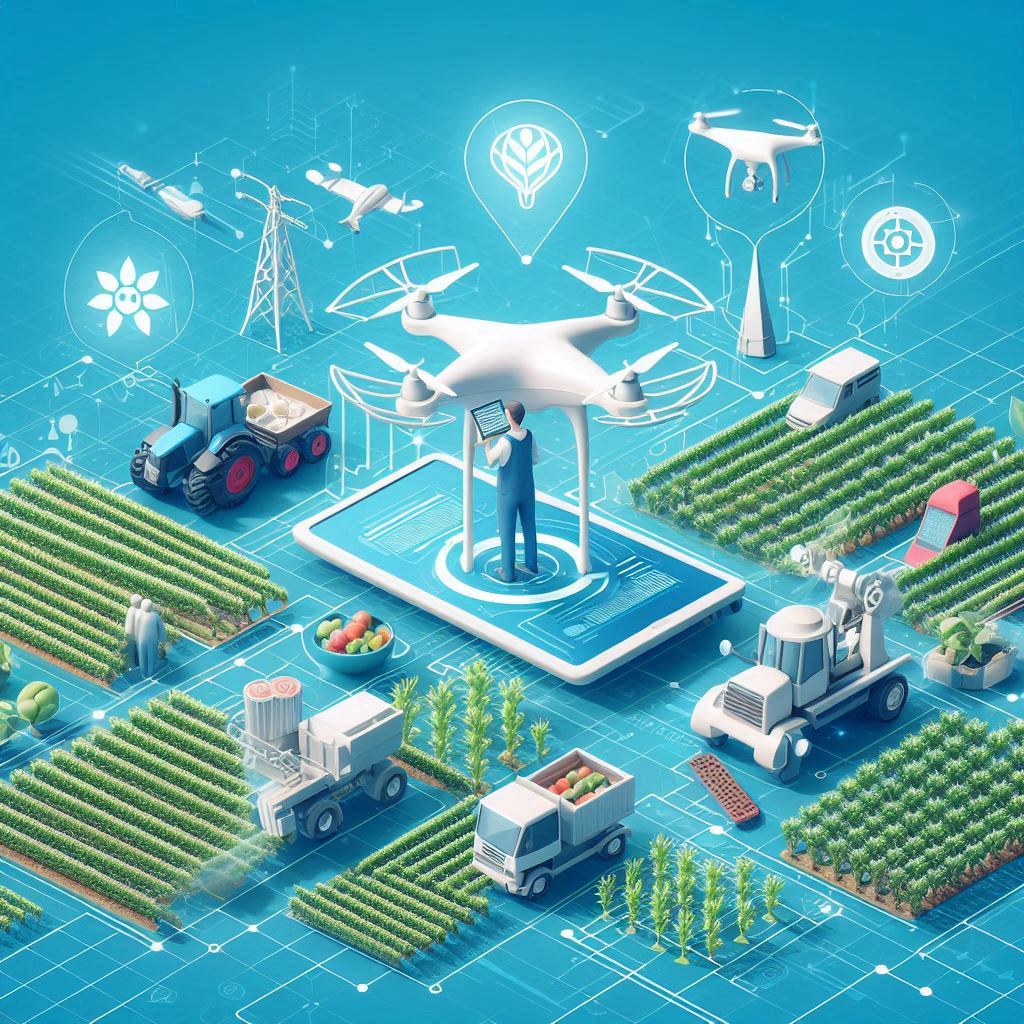
Before we start looking at the various uses of artificial intelligence (AI) in the agronomy sector. It’s important to remember what agronomy is, and isn’t.
Agronomy, like AI, is not just about one discipline, it’s about many. Agronomy includes all the sciences related to the world of agriculture. It includes the natural sciences (chemistry, biology, zoology…), economic and social sciences (finance, management…), STEM (Science, Technology, Engineering, and Mathematics).
Far from the paranoia (or stupidity) of some people too self-centered to believe that they are the world (Le satellite, espion permanent des agriculteurs français, La revue du Digitale, January 25, 2024), the real stakes of using AI (and related digital tools) in the fields of agronomy and agriculture will enable people who suffer from climatic hazards (droughts…), to make better use of the land, improve crop yields, improve crop irrigation… and solve food supply problems as far as possible.
Taken from the scientific study co-authored by Ahmad A & al (AI can empower agriculture for global food security: challenges and prospects in developing nations, Frontiers Artificial Intelligence), below is a list summarizing the different areas of AI applications in agronomy (and agriculture).
Different fields of application and their respective methodologies

with corresponding methodology, results and challenges.
Source: AI can empower agriculture for global food security:
challenges and prospects in developing nations,
Frontiers Artificial Intelligence.
Let’s not forget that millions of people around the world are not getting enough to eat, and some are even starving to death.
In short, AI is trying to help people who are really suffering.

between the study periods of 2000–2002 and 2014–2016 (percentages).
Data retrieved from the United Nations Sustainable Development Goals Report (2016).

with stunted growth, 2000 and 2014 (percentages).
Data retrieved from the United Nations Sustainable Development Goals Report (2016).
The United Nations report (United Nations Sustainable Development Goals Report, 2016) estimates that 98% of undernourished people come from developing regions.
After recalling the disciplines that make up agronomy as well as the use of AI in agriculture, in this summer, Muse™ invites you to go on a journey to discover how the potential of AI is being used for the development of agronomy across 5 continents.
We’ll start our journey with the Asian continent, followed by Oceania. We’ll then move on to the Americas. Then we’ll head for Africa. To conclude our journey, we’ll end our round-the-world tour on the Old Continent.
Before our plane takes off, the captain would like to remind you of a few figures to take into account (and remember) to understand the challenges of agriculture 4.0
According to the United Nations data portal (direct link to my research available here), in 2023, there will be 8,091,734,930 of us on our planet.
Global population breakdown, in 2023, by continent (Africa, America, Asia, Europe and Oceania):
Africa: 1,480,770,525
Americas: 1,041,794,258
Asia: 4,778,004,486
Europe: 745,602,875
Oceania: 45,562,787
According to the Global Report Food Crises (GRFC, 2024), 18 countries, or around 71.9 million people worldwide, are suffering from food insecurity due to climate change.

through the application of multiple, agreed-upon criteria.
Source: Food Security Information Network (FSIN)
—Global Report on Food Crises (GRFC) 2024—
Asia
The Asian continent in figures. More than 50% of the world’s population (4,778,004,486 people in 2023) lives on this continent. The Asian continent accounts for 1/5 of the world’s agricultural land.
Let’s start our world tour in India and more precisely in the province of Karnāṭaka to discover the company KisanRaja, a startup specializing in the use of IoT and Machine Learning (ML) in agriculture, more specifically in irrigation system management (AI for optimizing irrigation, India AI, 2018).
This system, based on IoT and analytical and conversational algorithms, makes it possible to manage the supply of water for irrigation as precisely as possible, while also helping to protect pumping equipment.
The system comprises wireless valve controllers and a cellular module for remote communication and system management. It uses data analysis and ML for water resource management. The system also includes a voice control module that supports different local dialects.

Source: Meet the Man Whose “KisanRaja” Smart Irrigation
Device Helps Over 34,200 Farmers! Angarika Gogoi.
Next, we head for Thailand, to Ban Mai to be precise. Farmers are beginning to swap their Bubalus bubalis (water buffalo) for drones. Since the 2020s, the Thai government has been implementing a modernization program in the agricultural sector.

an agriculture drone in a rice farm in Ban Yai, Thailand.
February 28, 2022. Thomson Reuters Foundation/Rina Chandran.
Source: Asian farmers turn to drones, apps for labor, climate challenges. Rina Chandran, Thomson Reuters Foundation, March 8, 2022
This modernization began after the Covid-19 pandemic, which created a labor shortage due to restrictions on the movement of workers.
As a result, a consortium of companies developed drones capable of seeding fields, spreading fertilizer or spraying weedkiller (Asian farmers turn to drones, apps for labor, climate challenges. Rina Chandran, Thomson Reuters Foundation, March 8, 2022).

Source: Hafeez A. & al. Implementation of drone technology for farm monitoring & pesticide spraying: A review, Information Processing in Agriculture, Volume 10, Issue 2, June 2023, Pages 192–203
As well as being cost-effective (purchase or rental with or without a drone pilot), the use of drones also enables safer handling of chemical products.
Oceania
After our stay on the Asian continent, we’re off to Oceania. For the record, in 2023, there were 45,562,787 people living on the continent.
We land in southern Australia, in Two Wells, at one of the Perfection Fresh group’s farms (In an Australian Tomato Farm, drones take the place of bees, Eco-Business, April 4, 2024).
Here, the various fruit and vegetable production processes are largely assisted by new technologies. Are they all? No, there’s still one process that resists robotization, and that’s the pollination of tomato plants (editor’s note: Perfection Fresh is a major tomato producer in Australia).
As Troy Topp, Perfection Fresh’s Managing Director, explains, pollination is a step carried out by hand by handlers. While in nature, bees perform this step, with greenhouse production, this step is performed either manually or using mechanical methods (the use of blowers, for example), the results of which are less conclusive than natural pollination.
The engineers at Perfection Fresh are trying to develop a new form of mechanical pollination, pollinating tomato plants using drones.
The use of drones for pollination has two objectives:
- To fill a labor shortage of greenhouse crops;
- To compensate for the very high mortality of bees (pesticides, climate change…) in a natural environment.
America
After visiting Asia and Oceania, let’s continue on to the American continent. All combined (north and south), America was home to 1,041,794,258 people in 2023 (¼ the population of the Asian continent). To begin our stay on the American continent, let’s head south to Brazil.
In 2028, agrochemicals conglomerate Bayer will launch one of its new products (Bayer is Expected to Launch Two Herbicides in the Coming Years: Icafolin and Convintro Duo, Revista Cultivar, February 1, 2024). The product we’re interested in here is ICAfolin. ICAfolin is unique in that it was designed using algorithms.
Over the decades, weeds and other pests (insects, fungi) have adapted to weedkillers and insecticides (What Could Conquer the Superweeds? Bayer and Others Turn to AI, Patrick Thomas, The Wall Street Journal, July 17, 2024). Agrochemical laboratories are engaged in a never-ending race to find an effective product.
To this end, some laboratories have succeeded in developing new molecules using AI, or more precisely, ML.
In addition to creating new molecules, the use of ML makes it possible to test the harmfulness of these molecules on humans.

with its AI CropKey technology at the company’s lab in Lyon, France.
Source: What Could Conquer the Superweeds? Bayer and Others Turn to AI—WSJ.
After Brazil, we’re off to Canada, and more specifically to Montreal, Quebec.
Located near Montreal, AquaVerti (AquaVerti’s Advanced Agriculture, Mon Carnet, Bruno Guglielminetti, July 9, 2024), is a hydroponic farm that uses AI and IoT to improve the quality of the vegetables it grows.

Source: AquaVerti Farms — Notre technologie | Québec, Canada
AquaVerti uses the IoT to collect data concerning, for example, the ambient air temperature (presence of a microclimate between the different floors of the structure), the oxygen level in the water…
Then, thanks to algorithms, agronomists and technicians are able to analyze the data collected in order to make decisions on how to obtain better production.
Africa
“Kenya could also be the cradle of homo notitia agriculturae.”
Alexandre MARTIN,
AI and Agronomy in the world, 2024
After the American continent, we’re now off to Africa. Africa is home to 1,480,770,525 people. But it’s also one of the continents hardest hit by famine.
According to the Global Food Crisis Report (GRFC 2024), in 2023, some 158.1 million people in Africa (35 countries) were affected by food insecurity (Food Security Information Network (FSIN)—Global Report on Food Crises (GRFC).
- Central and Southern Africa (13 countries): 49.6 million people
Source:
Food Security Information Network (FSIN)—Global Report on Food Crises (GRFC), p. 26, 2024.

of acute food insecurity in 13 countries in 2023.
- East Africa (8 countries): 64.2 million people
Source:
Food Security Information Network (FSIN)—Global Report on Food Crises (GRFC), p. 46, 2024.

of acute food insecurity in eight countries, 2023.
- West Africa and the Sahel (14 countries): 44.3 million people
Source:
Food Security Information Network (FSIN)—Global Report on Food Crises (GRFC), p. 65, 2024.

of acute food insecurity in 14 countries in 2023.
After this digression, let’s return to the use of AI on the African continent. Direction Nairobi, Kenya. It was in Kenya, considered to be part of the cradle of humanity that the first bones of Homo habilis (our common ancestor) were discovered.
Kenya could also be the cradle of homo notitia agriculturae. Farmers on the African continent have little data on their territories. Satellite survey data does exist, but it’s still paper-based and available at a prohibitive cost that local farmers can’t afford. International data and models also exist, but they are less accurate for the African continent.
In Nairobi, Kenyan startup Kate Kallot’s Amini is bridging the information gap by using drones and IoT sensors to view existing data. The Amini startup is able to collect, but also analyze this data to then transmit information or recommendations to farmers, insurers or governments, and at a lower cost (This Nairobi Startup is Using AI to Add Data Science to African Agriculture, Steven Melendez, Fast Company, June 20, 2024).
The Amini startup has decentralized the computing centers for these models. Instead of using remote infrastructures such as AWS (Amazon) or AZURE (Microsoft), with partnerships with Hewlett Packard Enterprise (HPE) and NVIDIA, startup Amini has centralized its computing centers on the African continent while employing local engineers and data scientists.
Let’s move on to Tanzania. In a scientific study written by Neema Mduma and Hudson Laizer (Machine Learning Imagery Datasets for Maize Crops: to Cases of Tanzania, Neema Mduma and Hudson Laizer, Data in Brief, volume 48, June 2023, updated June 2024), the researchers looked at disease detection on maize plants. It should be noted that maize cultivation is an important cash crop for many small-scale farmers, as well as an important food source for African tropical regions.
Maize crops are regularly subjected to diseases such as maize stripe phytovirus or maize lethal necrosis.
The aim of this study is, using a smartphone camera, to compile a set of over 18,000 images to generate a model for the creation of tools that will ultimately be used to help farmers improve the yield of their maize production by helping them diagnose their crops.
Europa
We leave Africa, and head for the last continent, Europe, the “Old Continent.” The name “Old Continent” has never been more aptly applied. Since the start of our round-the-world tour, we’ve seen that the use of AI in agriculture is improving crop yields, not just to earn more money, but to ensure a necessary quantity of food for people for whom it’s vital to feed themselves.
The European continent is home to some 745,602,875 people. Europe represents around 50% of the African continent (1,480,770,525 people) and the European continent represents around 25% of the Asian continent (4,778,004,486 people).
We begin our tour of Europe with France, as this country has long been a rural one, whereas its European neighbors, such as the UK, saw the end of small-scale farming as early as the 18th century.
However, it was at the end of the Second World War and with the financial help of the Marshall Plan that France saw the metamorphosis of its agricultural exploitation.
This lack of innovation in French agriculture is also mentioned (half-heartedly) by the Senate’s information commission (Compétitivité de la ferme France, Rapport d’information n° 905 [2021-2022], Sénat, République française filed September 28, 2022). By way of information, the “French AgriTech” program has only been launched since August 2021 (Agriculture et innovation : lancement de la French AgriTech, press kit, Ministry of Agriculture and Food Sovereignty, August 31, 2021), i.e., later in developing countries.
However, in the field of research, many projects are underway with, for example, the AGROCONNECT project (AGROCONNECT, Arvalis, April1, 2024). The aim of the AGROCONNECT project is to create a test platform to demonstrate the effectiveness of robotized cultivation systems.
After France, we’re off to Belgium, to Brussels to be precise. There are no fields to cultivate here in Brussels, but the city is home to the European Commission. The European Commission is the executive body of the European Union (EU). It is here that new legislation and policies are proposed and implemented. It is also here that the EU budget is managed.
But let’s take a look at the SQAT project. SQAT, which stands for Soil Quality Analysis Tool, is a tool which, after collecting information in the field, provides maps containing certain types of data (cf. the Amini startup in Nairobi—This Nairobi startup is using AI to add data science to African agriculture, Steven Melendez, Fast Company, June 20, 2024).
On the European continent, we can see that there are many projects underway. But these remain projects, and compared with the rest of the world, there are few concrete examples of the use of these new technologies.
We can see a certain reticence (technophobia?) on the part of European farmers, who are all too often used to being financially compensated for crop failures.
This is only a suggestive and non-exhaustive selection of articles. There are other articles available on the subject, whether on the development of new technologies, new production techniques or the reduction of the drudgery of agricultural tasks.
We can see that, for the most part, it’s the less affluent countries that are using and recognizing the true value of these new technologies.
But we can already see the benefits of AI in agriculture. We can see that, thanks to AI, government agencies and companies can improve data collection so that they can enrich the databases that will then be used by farmers.
The same data collected and processed is used to improve resource management (water, etc.). As more and more countries face major climate change, resources such as water are becoming increasingly scarce for some.
Image recognition also enables farmers to prevent plant diseases.
Another point is the development of drones, which have created jobs (pilot and/or drone rental). But they have also made agricultural work less arduous and less dangerous for farmers.
AI, in the multidisciplinary sense of the term, is also helping to develop new forms of cultivation and better crop management (hydroponics). AI can also be used to develop new products to combat phytoviruses, or to create new herbicides and fungicides.
But AI is not just a tool for destruction, it’s also a tool for creation. The use of AI also makes it possible to create seeds that are more resistant to the various consequences (drought, insects, etc.) of climate change.
We have also seen that disadvantaged countries are the most ardent supporters of AI as a means of survival. And this despite the various challenges that prevent them from being able to apply the benefits of AI in agriculture (Ahmad A & al., AI can empower agriculture for global food security: challenges and prospects in developing nations, Frontiers Artificial Intelligence).
These various challenges are of a financial nature, the setting up of specialized infrastructure under specific conditions, having qualified personnel to manage these infrastructure, the absence of appropriate regulations, a lack of awareness of new technologies and a lack of access to knowledge (illiteracy), a lack of data (history) and cultural diversity all complicate the implementation of AI-based tools.
To conclude this article, I would ask you to remember just one sentence:
“Don’t confuse modernity to be ‘high-tech’ with modernity to survive.”
Anonymous.